
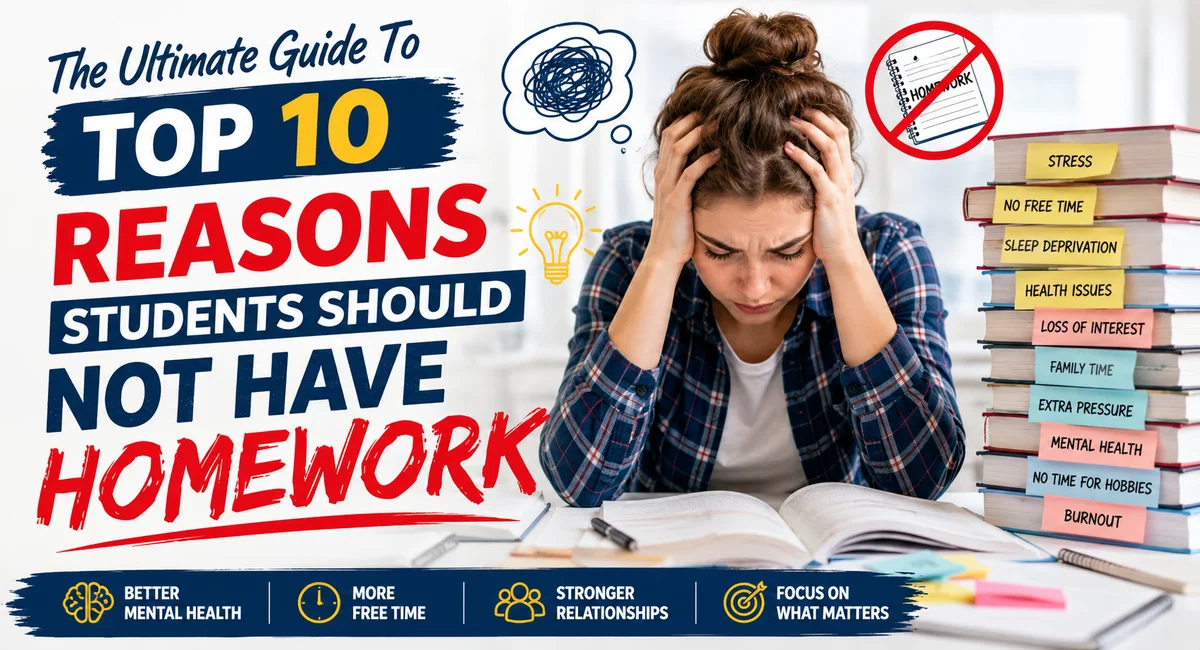
The Ultimate Guide To Top 10 Reasons Students Should Not Have Homework
Homework is a part of school life that has been passed down from generation to generation. Students get a worksheet after class, a project due Friday, and a chapter due tomorrow and none of them sounds unreasonable. The problem starts when several little assignments pile up unless a student’s entire evening feels like an extension of the school day.
Learning is important, but so are sleep, family time, exercise, friendships, hobbies, and simply having a chance to switch off. Data found that students have reported spending an average of 1.5 hours a day on homework during a typical school week and 31% reporting more than two hours daily. That has raised an important question: when does practice stop helping and start getting in the way?
Reasons Students Should Not Have Homework
Homework often burdens the student’s daily life. The following are 10 reasons why students should not have homework.
1. Reduce Time for Sleep
Sleep is not a wasted time for a student, but it is part of learning. Children aged 6–12 usually need 9–12 hours of sleep, and teenagers aged 13–17 generally require 8–10 hours. Insufficient sleep is still common among school-age students.
A student who spends an extra two hours finishing algebra at night may technically complete the assignment, but their lost sleep can make the next school day harder for them. Tired students often struggle to concentrate, regulate emotions, remember information and participate actively in class. If the student works at 11 p.m., that does not necessarily mean more learning at 8 a.m.
2. Increase Academic Stress
Schools already have tests, deadlines, grades, presentations, and social pressure in academic life. Homework can add another layer to that workload for students.Imagine a student has mathematics exercises, a science report, reading for English and a history presentation that are due for the next morning. None of them is unreasonable alone. They all can create a stressful evening together.
Students may start to worry about their unfinished work before they even arrive home. This constant feeling of being behind can turn the simple education into something that they endure instead of something they enjoy.
3. Need Time Outside School
An education of a young person does not happen only beside a textbook. Activities like playing football, helping at home, drawing, pursuing music, reading for pleasure, talking with friends, or simply spending time outdoors can help you develop communication, independence, creativity, and problem-solving skills.
These activities can help them with mental recovery. A student who is spending every afternoon and evening completing schoolwork often has fewer opportunities to discover interests that cannot be measured by grades.
4. Hurt Family Time
Home is considered to be more than another classroom if students have to do homework.It can create tension for parents when they are expected to explain concepts that they may not understand themselves or when a child becomes frustrated when doing an assignment. Most families have flexible schedules and plenty of educational resources, while others often do not. Students who need substantial outside help may have an advantage over classmates who are expected to work independently.
Families often search for outside academic help or services like the best coursework writing service in NZ that might appear convenient. It is not ideal to rely heavily on third-party help as it can also reduce the opportunity for students to develop their own skills. The better solution is to reduce workloads and provide accessible support within school.
5. Does Not Always Improve Learning
The strongest argument against excessive homework is not that each assignment is useless for the student. The main point is that quantity does not automatically equal quality.PISA 2022 found a positive association between mathematics performance and homework time up to around two hours per day, with students reporting 30–60 minutes scoring higher than those students who are reporting less than 30 minutes, after accounting for socioeconomic and school factors.
This one is crucial as it can challenge an extreme “no homework ever” position. You can consider moderate and purposeful practice to help you the most. The concern is what happens when assignments become excessive, repetitive, or disconnected from meaningful learning.
6. Encourage Students To Focus On Completion
When homework becomes a daily obligation for the student, it can become more important to finish instead of understanding.A student may copy an answer, rush through ten questions, search for a solution online, or ask someone else to explain the entire assignment simply just to meet a deadline.
This can create a dangerous habit that schoolwork becomes something to submit rather than something that they need to understand. This is one reason that people are continuously asking why students should not have homework when the workload becomes excessive. The issue is not practice itself for students, but it is whether the task can actually produce useful learning.
7. Limit Creativity
Creativity requires a room or a space. It cannot always appear on command after six hours of structured lessons. Some of the most valuable ideas emerge when students are bored, experimenting, curious, or exploring something without a grade; they get attached to it.
A teenager who spends the evening writing a song, photographing nature, building something, or experimenting with a computer program can often learn valuable skills without completing a traditional worksheet. If the teacher gives too much prescribed work, it can crowd out those opportunities.
8. Create Inequality Between Students
Every student does not go home to the same circumstances. One student may have a quiet bedroom, a laptop, fast internet, private tutoring, and parents available to help. Another one may share a room, care for younger siblings, have limited internet access, or work after school.
The assignment they both are getting is technically identical, but the conditions are not. Some students may consequently turn towards the cheap assignment writing service in NZ simply because they are struggling to manage competing demands. This is not solving the educational problem, but highlighting it.
9. Take Away From Physical Activity
Students often need movement just as much as they need academic practice. Exercise can support physical health, concentration, mood, and general well-being. When homework is regularly occupying the hours after school, physical activity can be the first thing they need to push aside.
The pattern is often easy to imagine: school ends, the student gets home, eats quickly, starts homework, takes a short break, returns to homework, and finally goes to bed. This routine leaves little space for movement for the student, but over time, that matters.
10.Make Students Dislike Learning
The biggest problem is the emotional point of the students. A student who once enjoyed science may start to associate it with worksheets. Someone who loved reading may begin to see their books as nothing more than assignments. A child who enjoyed mathematics may eventually dread opening a textbook. Good education should encourage curiosity and not punish it.
Frequently Asked Questions
1. How much homework is considered to be reasonable?
There is no universal amount of homework that can work best for every student or age group. Workload should be reasonable enough to leave enough time for sleep, physical activity, meals, family responsibilities, and relaxation. Schools must consider the total workload for every subject instead of setting isolated limits.
2. Why are teachers continuously assigning homework?
Teachers often use homework to reinforce lessons, assess understanding of students, provide practice, prepare students for future material, or develop independent study habits. The problem is not necessarily about the purpose, but it is whether the assignment achieves that purpose efficiently.
3. What can students do when they have too much homework?
If students are facing too much homework, then they can speak with teachers, break large assignments into smaller tasks, prioritise deadlines, and ask for clarification when instructions are unclear to them. If several subjects have major deadlines at once, you can discuss the workload with a teacher or counsellor to help you identify a practical solution.
Final Thoughts
Homework is not automatically bad for students, and research shows that moderate amounts of homework can support learning, particularly when assignments are purposeful. The real concern is excessive and repetitive work that consumes sleep, exercise, family time, creativity, and genuine curiosity. Students need challenging education, but they are also required to live outside the classroom. The best question is not that every piece of homework should disappear, but that each task deserves the time it takes.